
Use Warehouse as Control Center Instead of Just Store Room
Sri Haryono, ST, MBA
Executive Board
22 June 2026
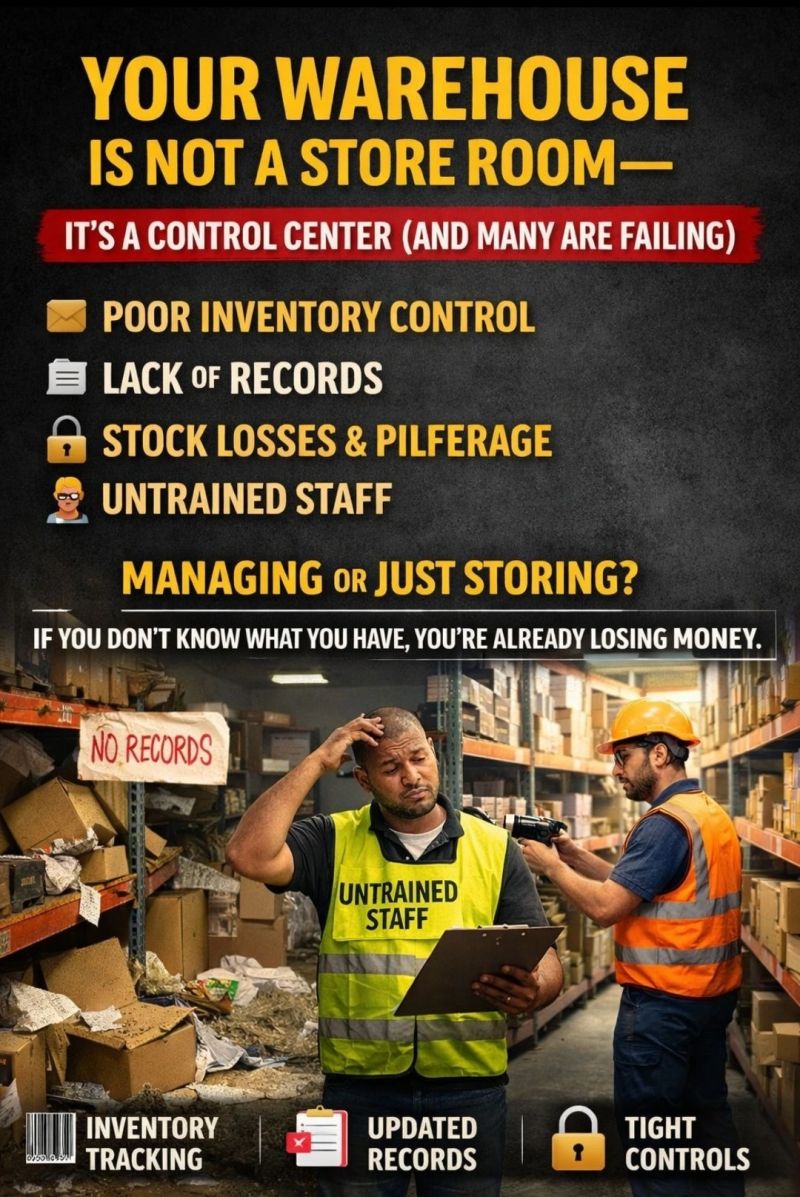
Many companies treat the warehouse as nothing more than a storage facility, a place where goods sit until they are needed. Pallets come in, pallets go out. As long as there is space to store items, everything seems fine.
In today’s competitive and data-driven business environment, that mindset is dangerously outdated. A warehouse is not a passive storage room. It is a control center of operations.
1. Inventory Tracking
Inventory tracking is the systematic process of monitoring the movement, location, quantity, and status of inventory within the warehouse and across the supply chain. Without inventory tracking, a warehouse becomes a blind storage space. With it, the warehouse becomes an operational control tower. Effective tracking allows management to:
- Optimize stock levels
- Reduce carrying costs
- Improve order fulfillment speed
- Increase service reliability
- Enable data-driven decision-making
2. Record Update
Many warehouses fail not because of theft or demand issues, but because records are not updated consistently. When records are outdated, management decisions become flawed. If the system says 500 units are available but actual stock is 300, the company risks overselling and disappointing customers.
3. Record Accuracy
Inaccurate records create hidden losses:
- Emergency purchases at higher prices
- Expedited freight costs
- Customer penalties
- Lost contracts
- Excess safety stock
- Working capital inefficiency
Instead of relying only on annual stock takes, modern warehouses use cycle counting:
- High-value items: counted weekly
- Medium-value items: counted monthly
- Low-value items: counted quarterly
This prevents large discrepancies from accumulating.
4. Tight Control
Warehouses contain high-value assets. Weak control invites:
- Pilferage
- Internal theft
- Unauthorized access
- Fraud
- Stock manipulation
- Shrinkage
Even small losses accumulate significantly over time. Tight control protects not only inventory but also company reputation.
Transforming the warehouse yields measurable financial benefits:
1. Reduced Carrying Cost
2. Lower Shrinkage
3. Improved Cash Flow
4. Increased Sales
5. Lower Operational Cost
Warehouse transformation requires leadership commitment:
- Clear vision
- Investment in systems
- Training programs
- KPI-driven management
- Zero tolerance for non-compliance
To transform warehouse operations:
Step 1: Conduct Gap Assessment
- Review accuracy level
- Identify process weaknesses
Step 2: Implement Inventory Tracking System
- Barcode/RFID
- WMS integration
Step 3: Establish Record Update Discipline
- Define SOP
- Train staff
- Enforce compliance
Step 4: Improve Record Accuracy
- Launch cycle counting
- Analyze discrepancies
Step 5: Strengthen Tight Control
- Physical security
- System access control
- Audit trails
Step 6: Monitor KPIs
- Accuracy %
- Shrinkage %
- Turnover ratio
- Service level
Berita dan Opini ALI Terbaru
Why It is Important to Maintain High-Level On-Time Shipment
06 July 2026
In today’s fast-paced and hyper-competitive business environment, on-time shipment has become more than just a logistics metric. It is a promise, a differentiator, and a reflection of operational excellence. In an age where customer expectations are shaped by instant gratification and next-day deliveries, reliability in fulfilling delivery promises defines how customers perceive a brand’s value and trustworthiness.Best-in-class companies achieve 99.5% on-time shipment performance. That level of precision does not happen by accident. It is a result of disciplined processes, integrated technology, robust supply chain management, and a deep understanding that customer satisfaction is built on consistency.The Customer Perspectivea. Delivery Reliability Equals Brand TrustWhen a business delivers on time consistently, it strengthens customer trust. This trust compounds over time, transforming casual buyers into loyal customers. In industries such as FMCG, retail, automotive, and e-commerce, on-time performance is often directly tied to customer retention rates.b. Perceived Quality and ProfessionalismEven when product quality is identical, customers perceive the more reliable supplier as higher quality. Reliability conveys professionalism, control, and competence.c. Customer Experience and Emotional ConnectionDelivery punctuality affects the overall customer experience. Imagine a customer planning an event, relying on your product to arrive at a specific time. A delay disrupts not only logistics but also emotions.The Financial Impact of On-Time Shipmenta. Revenue Protection and GrowthLate deliveries can result in canceled orders, chargebacks, or lost customers. For B2B relationships, penalties for not meeting delivery commitments can be severe, including loss of preferred supplier status. Conversely, consistently on-time companies gain repeat orders and long-term contracts.b. Cost Efficiency and Waste ReductionPoor on-time performance often stems from inefficiencies. When operations are designed for reliability, waste is reduced, fewer urgent shipments, fewer customer complaints, and fewer returns.c. Working Capital OptimizationConsistent delivery performance enables leaner inventory management. Businesses that can trust their delivery timelines can operate with reduced safety stock levels, freeing up working capital for strategic investments.d. Avoiding Penalties and Service-Level BreachesMany B2B contracts include SLAs. Missing delivery deadlines can trigger financial penalties or reputational damage. Maintaining 99.5% on-time shipments helps safeguard contractual integrity and long-term partnerships.The Operational Backbone of High On-Time Shipmenta. Accurate Demand Forecastingb. Integrated Planning and Schedulingc. Warehouse and Inventory Optimizationd. Transportation Reliability and Visibilitye. Supplier Collaborationf. Supply ChainAutomation
👁️ 105 kali
Use Warehouse as Control Center Instead of Just Store Room
22 June 2026
Many companies treat the warehouse as nothing more than a storage facility, a place where goods sit until they are needed. Pallets come in, pallets go out. As long as there is space to store items, everything seems fine.In today’s competitive and data-driven business environment, that mindset is dangerously outdated. A warehouse is not a passive storage room. It is a control center of operations.1. Inventory TrackingInventory tracking is the systematic process of monitoring the movement, location, quantity, and status of inventory within the warehouse and across the supply chain. Without inventory tracking, a warehouse becomes a blind storage space. With it, the warehouse becomes an operational control tower. Effective tracking allows management to:- Optimize stock levels- Reduce carrying costs- Improve order fulfillment speed- Increase service reliability- Enable data-driven decision-making2. Record UpdateMany warehouses fail not because of theft or demand issues, but because records are not updated consistently. When records are outdated, management decisions become flawed. If the system says 500 units are available but actual stock is 300, the company risks overselling and disappointing customers.3. Record AccuracyInaccurate records create hidden losses:- Emergency purchases at higher prices- Expedited freight costs- Customer penalties- Lost contracts- Excess safety stock- Working capital inefficiencyInstead of relying only on annual stock takes, modern warehouses use cycle counting:- High-value items: counted weekly- Medium-value items: counted monthly- Low-value items: counted quarterlyThis prevents large discrepancies from accumulating.4. Tight ControlWarehouses contain high-value assets. Weak control invites:- Pilferage- Internal theft- Unauthorized access- Fraud- Stock manipulation- ShrinkageEven small losses accumulate significantly over time. Tight control protects not only inventory but also company reputation.Transforming the warehouse yields measurable financial benefits:1. Reduced Carrying Cost2. Lower Shrinkage3. Improved Cash Flow4. Increased Sales5. Lower Operational CostWarehouse transformation requires leadership commitment:- Clear vision- Investment in systems- Training programs- KPI-driven management- Zero tolerance for non-complianceTo transform warehouse operations:Step 1: Conduct Gap Assessment- Review accuracy level- Identify process weaknessesStep 2: Implement Inventory Tracking System- Barcode/RFID- WMS integrationStep 3: Establish Record Update Discipline- Define SOP- Train staff- Enforce complianceStep 4: Improve Record Accuracy- Launch cycle counting- Analyze discrepanciesStep 5: Strengthen Tight Control- Physical security- System access control- Audit trailsStep 6: Monitor KPIs- Accuracy %- Shrinkage %- Turnover ratio- Service level
👁️ 108 kali
Where to Start: The Journey to Operational Excellence
22 June 2026
In the world of business, many organizations aspire to achieve world-class performance. They invest in technology, hire talented people, implement sophisticated systems, and launch ambitious transformation programs. Many of these initiatives fail because organizations attempt to jump directly to advanced methodologies without first building a strong foundation.A. 5S – Creating StructureThe 5S is a workplace organization methodology originating from Japan. The primary objectives of 5S include:- Creating an organized work environment- Establishing clear procedures and instructions- Making abnormalities visibleMany organizations underestimate the importance of 5S because it appears simple. However, this stage creates the discipline required for all future improvements.B. Kaizen – Building Continuous Improvement CultureKaizen means "continuous improvement." Rather than waiting for major breakthroughs, Kaizen encourages employees to make small, incremental improvements every day.Many companies make the mistake of believing that improvement is the responsibility of managers, consultants, or specialists. Kaizen teaches that everyone is responsible for making work better.Kaizen creates a culture where employees actively seek opportunities for improvement rather than simply accepting problems as normal.C. Lean – Achieving StabilityLean focuses on creating stable and efficient processes, revolves around a simple principle: eliminate activities that do not create value for customers.Lean aims to create smooth flow throughout the value stream, helps organizations become faster, more responsive, and more cost-effective.D. Six Sigma – Developing CapabilitySix Sigma focuses on reducing process variation, addresses the issues through data-driven analysis.Six Sigma enables organizations to achieve highly predictable outcomes.Instead of merely reacting to problems, organizations begin controlling processes proactively. The result is improved quality, reduced defects, lower costs, and higher customer satisfaction.E DFSS – Building RobustnessDesign for Six Sigma) represents the highest level of operational maturity, focuses on designing excellent processes and products from the beginning.Many organizations spend substantial resources fixing problems after products or processes are launched. DFSS seeks to prevent those problems from occurring in the first place.The philosophy is simple, "It is easier and cheaper to design quality into a system than to inspect defects out of it later."DFSS involves:- Understanding customer requirements deeply- Translating customer needs into design specifications- Creating robust designs that perform consistently under varying conditionsOrganizations cannot achieve world-class performance without progressing through the stages of maturity.
👁️ 87 kali